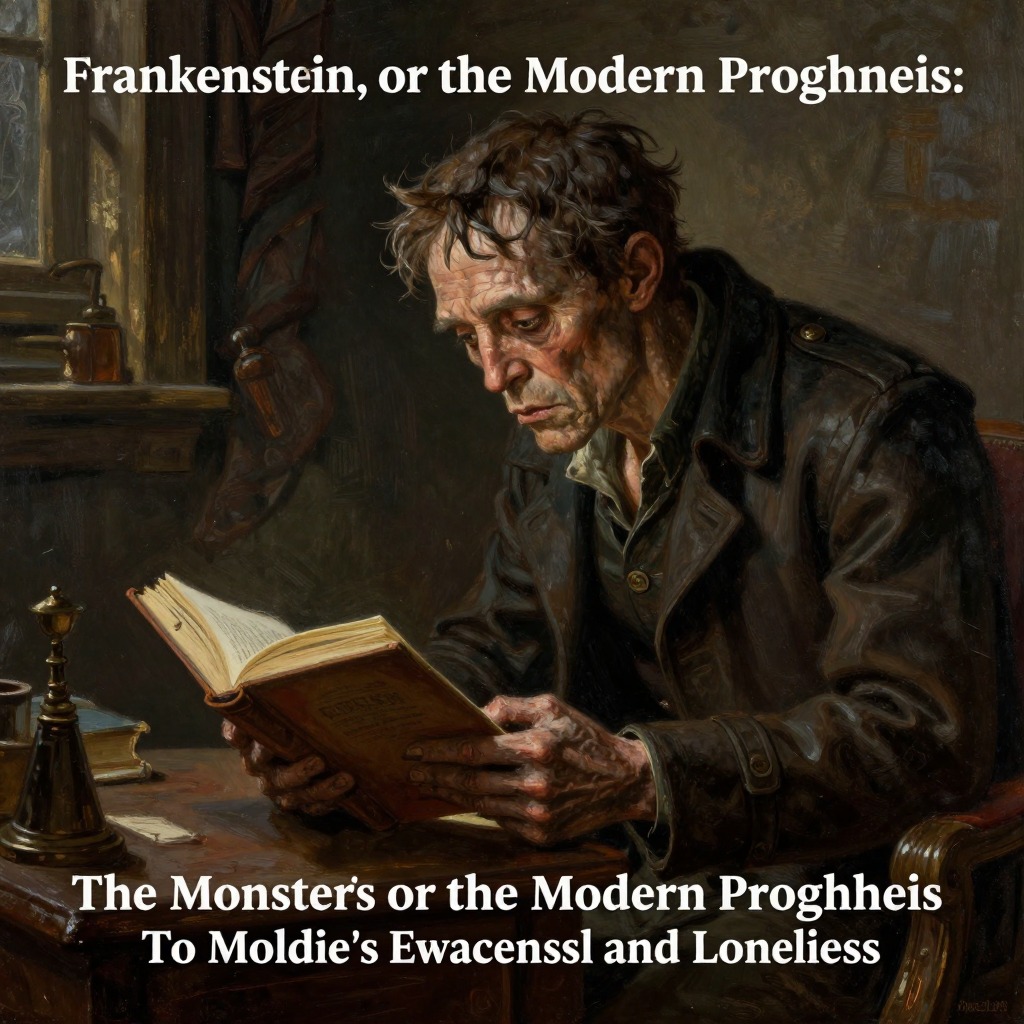
De Laceys' cottage
The De Laceys' cottage is the rural German dwelling where the monster secretly observes human family life, learns language and social structures, and makes his only attempt at companionship, only to be violently rejected, an event that transforms his benevolent aspirations into vengeful hatred and sets the novel's tragic trajectory in motion.
Location and Description
The cottage was situated against the back of a larger cottage, with a pig sty and a clear pool of water on the exposed sides. The monster's place of refuge was a low hovel constructed of wood, so low that he could with difficulty sit upright in it. No wood was placed on the earth floor, but it was dry, and although the wind entered through innumerable chinks, he found it an agreeable asylum from the snow and rain. He covered every crevice by which he might be perceived with stones and wood, arranging them so he could move them to pass out. All the light he enjoyed came through the pig sty, and that was sufficient for him. He carpeted his dwelling with clean straw. The floor was a little raised, keeping it perfectly dry, and by its vicinity to the chimney of the cottage it was tolerably warm. One of the windows of the cottage had formerly occupied a part of the hovel, but the panes had been filled up with wood, leaving a small and almost imperceptible chink through which the eye could just penetrate. Through this crevice a small room was visible, whitewashed and clean but very bare of furniture.
The Monster's Observation and Education
From his hovel, the monster watched the daily routine of the De Lacey family: the blind old father, his son Felix, and his daughter Agatha. He observed their gentle manners, their love and respect for one another, and their poverty. He learned the names of the cottagers—"father," "Agatha," "Felix"—and the words for familiar objects like "fire," "milk," "bread," and "wood." He discovered that they communicated through articulate sounds, a "godlike science" he ardently desired to master. He also learned the science of letters from the book Felix used to instruct Safie, Volney's Ruins of Empires, which gave him a cursory knowledge of history, governments, and religions. The monster secretly assisted the family by gathering wood at night, which he left outside the cottage, and by clearing their path of snow. The family, astonished by these invisible labors, sometimes uttered the words "good spirit" and "wonderful." The monster's admiration for the cottagers grew, and he longed to join them, but he dared not, remembering the violent treatment he had received from the villagers he had previously encountered.
The Attempt at Friendship and Its Failure
After months of observation and language acquisition, the monster resolved to introduce himself to the blind old man, De Lacey, when his children were away. He entered the cottage, and De Lacey, unable to see his hideous form, spoke kindly to him, offering to help him. The monster, calling himself an unfortunate and deserted creature, confessed that he was about to seek the protection of friends who were prejudiced against him. De Lacey assured him that the hearts of men, when unprejudiced, are full of brotherly love. The monster, seizing the moment, revealed that De Lacey and his family were the very friends he sought. At that instant, Felix, Safie, and Agatha returned. Agatha fainted, Safie rushed out, and Felix, in a transport of fury, tore the monster from his father's knees, dashed him to the ground, and struck him violently with a stick. The monster, though capable of tearing Felix limb from limb, refrained, overcome by pain and anguish, and escaped to his hovel.
Aftermath and Destruction
The monster, now consumed by rage and despair, returned to his hovel. The next day, he heard Felix telling a companion that they could never again inhabit the cottage, as the life of his father was in the greatest danger due to the dreadful circumstance. The monster never saw any of the De Lacey family again. His protectors had departed, breaking the only link that held him to the world. For the first time, feelings of revenge and hatred filled his bosom. That night, he placed a variety of combustibles around the cottage, and after destroying every vestige of cultivation in the garden, he waited for the moon to sink. When it did, he fired the straw, heath, and bushes he had collected. The wind fanned the fire, and the cottage was quickly enveloped by the flames, which clung to it and licked it with their forked and destroying tongues. Once convinced that no assistance could save any part of the habitation, he quitted the scene and sought refuge in the woods.
Significance
The De Laceys' cottage represents the monster's only experience of domestic happiness and his sole opportunity for integration into human society. Its destruction marks the definitive end of his benevolent aspirations and the birth of his vengeful mission. The cottage is a space of both education and rejection, where the monster learns the virtues of human companionship only to be violently excluded from it, a rejection that directly precipitates the novel's central tragedies, including the murders of William Frankenstein, Justine Moritz, Henry Clerval, and Elizabeth Lavenza.